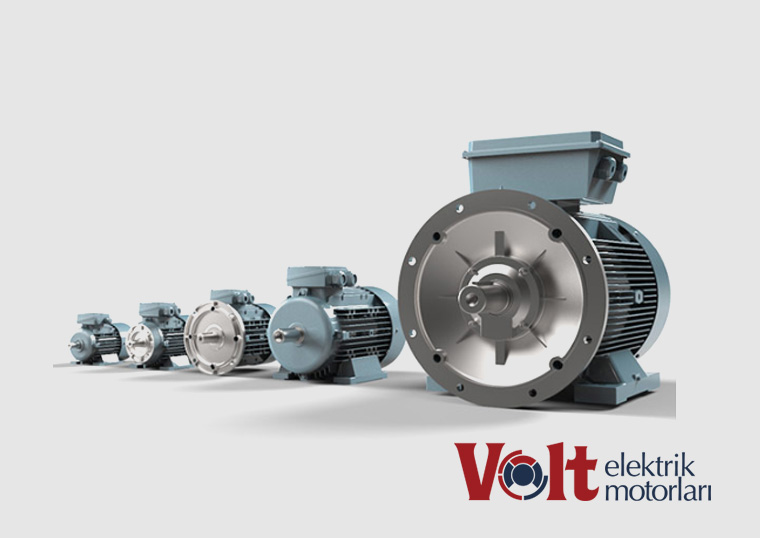
The structure of 1-phase asynchronous motors consists of two basic components, stator and rotor, as in 3-phase asynchronous motors. The stator forms the fixed part of the motor. The stator contains the stator core and field windings. The stators of 1-phase asynchronous motors usually have 2 windings, the main and the auxiliary winding. The rotor is the rotating part of the engine. The rotors of the ring induction motors have windings, while the rotors of the squirrel-cage induction motors have short-circuited busbars. Volt Motor's industrial asynchronous motor product range also consists of squirrel-cage asynchronous motors.
In asynchronous motors, the frequency of the rotating field formed in the air gap and the rotation frequency of the rotor are not the same. For this reason, these motors are called asynchronous. The frequency of the rotating field in the air gap depends on the supply frequency of the motor and the number of poles and does not change with the load of the motor, while the rotation frequency of the rotor changes depending on the load. As the load increases in the operating region of the engine, the engine speed decreases, and as the load decreases, the speed increases. The engine speed is at its highest at idle. The rotational speed of the motor in the motor operating range of the asynchronous motor cannot exceed the rotational speed of the rotating field. The number of revolutions of the rotating field is calculated as follows:
- N: Number of revolutions of the rotating field [rpm]
- f: Supply frequency [Hz]
- P: Number of poles of the stator winding
- N = 120 xf/P
As can be seen from here, the rotating field speed of a 2-pole motor will be 3000rpm and the rotary field speed of a 4-pole motor will be 1500rpm. The change in the speed of the asynchronous motor at different loads can be seen in the torque-speed graph below. In single-phase asynchronous motors, alternating currents with different phases must pass through the main and auxiliary windings in order for the starting torque to occur. To achieve this, a series capacitor is connected to the auxiliary winding circuit. Thus, a two-phase motor is formed. In order to increase the starting torque of the motor, in addition to the permanent capacitor, a starting capacitor can be used, which will be active only during the start-up and will be disabled with a mechanism when the start-up is completed. Centrifugal (centrifugal) switch is used in volt motor monophase products to deactivate the starting capacitor.

- Volt Motor 1-phase asynchronous motor types;
- Motors with Permanent Circuit Capacitors: There are only permanent circuit capacitors in these motors. The permanent-circuit capacitor is active both at starting and running of the motor.
- Motors with Start-Up and Permanent Circuit Capacitors: In addition to the permanent circuit capacitor, these motors also have a start capacitor. The start capacitor is only active at the start and is deactivated by the centrifugal switch after the engine starts. The permanent circuit capacitor is active both at the start and at the start of the motor.
- 1 Phase asynchronous motors;
- It can be used by starting directly from the mains (DOL).
- Standard motors can be used only in 50Hz or only 60Hz networks.
- Standard motors can be operated by being fed from 220 V residential networks.